
Buying software feels like the safe choice.
No long delivery cycles.
No engineers to hire.
No systems to maintain.
Just a credit card, a free trial, and the feeling that a problem has been solved.
Until, slowly, it hasn’t.
This is the buy trap: when SaaS decisions that make sense individually accumulate into a fragmented, expensive, and fragile operating model that works against the business instead of supporting it.
How a Spreadsheet Exposed the Problem
A Munich-based engineering consultancy expected to spend around €280,000 per year on software.
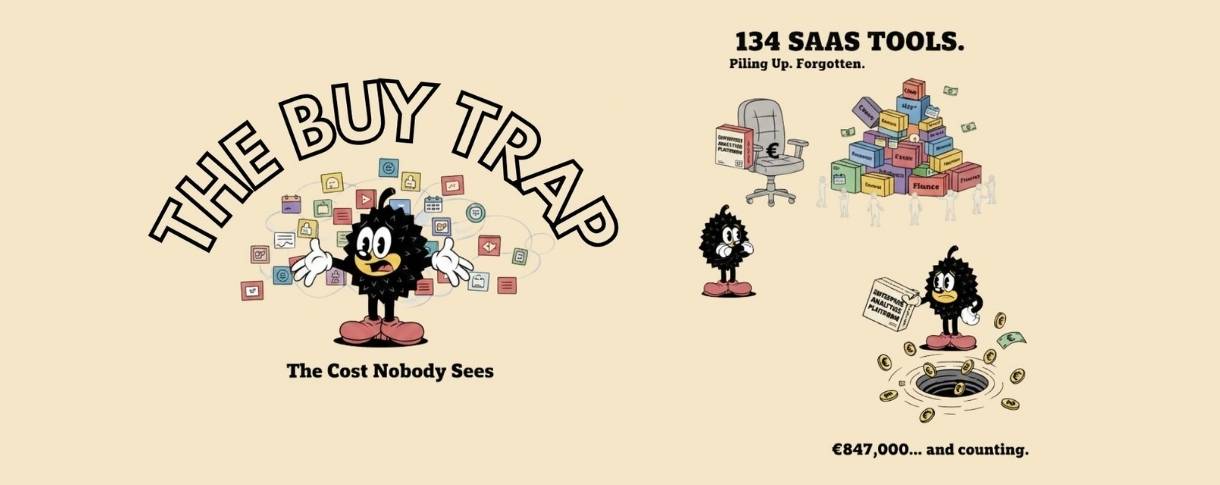
When the CFO asked for a full audit, the number came back at €847,000.
The company was running 134 SaaS applications. IT officially managed 51 of them. The rest had been purchased by teams on credit cards, expensed quietly, and forgotten once projects ended or employees moved on.
Fourteen tools were being used for project management alone. Different teams. Different data. No unified view of delivery or profitability. What looked like flexibility had quietly become fragmentation.
The most painful discovery was a €3,800-per-month analytics platform signed for a client pitch that failed. Nobody had logged in for over a year. The contract had auto-renewed. The cancellation notice went to someone who no longer worked there.
Nothing about this situation was reckless. Every decision had made sense at the moment it was taken. That’s exactly why the buy trap is so dangerous.
Why SaaS Sprawl Sneaks Up on You
SaaS doesn’t feel expensive because the costs are distributed. A few dozen euros here. A per-seat license there. No large upfront investment to trigger scrutiny.
But at scale, the math catches up.
By 2025, companies spend several thousand euros per employee per year on SaaS, and that number is growing far faster than overall business costs. More than half of all licenses go unused. Tools bought for growth that didn’t happen, for employees who left, or for features that never delivered value.
What looks like agility at team level becomes inefficiency at company level.
Lock-In Without a Contract
Most organizations think of lock-in as a contractual problem. In reality, it’s structural.
Data ends up trapped in proprietary formats that are technically exportable but practically unusable elsewhere. Workflows adapt to the quirks of a tool until the tool becomes the process. Integrations pile up, linking systems so tightly that removing one breaks several others. Over time, teams build expertise around a specific platform, making switching feel risky even when the costs no longer make sense.
The result is dependence without intention. Not because a contract forces it, but because complexity does.
When SaaS Turns Into Custom Software
SaaS promises standardization. Reality demands adaptation.
A sales process doesn’t quite fit the default stages. Reporting needs one extra field. An integration requires data that isn’t exposed cleanly. Each adjustment seems harmless.
Two years later, the company is running heavily customized SaaS. They pay the subscription. They pay consultants to maintain the custom logic. They pay again when platform updates break those customizations.
At that point, the business is carrying the cost profile of custom software, without the control that usually justifies building it in the first place.
The Shadow IT Blind Spot
In the Munich firm, more than half of the tools in use were unknown to IT.
That’s not unusual. As teams move faster than governance processes, they route around them. The result is software handling client or company data without security review, compliance validation, or ownership.
By the time leadership becomes aware, sensitive data has already spread across systems nobody fully controls. Shadow IT isn’t a people problem. It’s a systems problem — a sign that official channels are too slow or too rigid for how the business actually operates.
The Real Cost of Buying
The €847,000 subscription bill was only the visible layer.
Behind it sat integration costs to keep tools talking to each other, ongoing training overhead as employees navigated an ever-changing stack, and significant opportunity cost. Time spent managing tools was time not spent improving processes or serving clients.
When those factors were added in, the true cost of SaaS sprawl approached €1.1 million per year. Not because the company bought software, but because nobody designed the system those tools were supposed to support.
Buying Is Not the Problem
Here’s the uncomfortable truth: most companies should still buy more software than they build.
The mistake isn’t buying. It’s buying reactively, tool by tool, without an operating model behind the decisions.
Software that doesn’t create competitive advantage should be standardized. Payroll, expenses, baseline CRM capabilities ; these are not places to innovate. They are places to minimize cognitive load and operational drag.
But buying well requires discipline. Visibility. Clear ownership. And an exit strategy that exists before the contract is signed.
The Black Durian Perspective
The build trap and the buy trap are not opposites. They’re symptoms of the same issue: decisions made in isolation instead of at system level.
At Black Durian, automation is not about adding tools or replacing them. It’s about designing an operating model where technology decisions reinforce each other instead of fighting for attention and budget.
Before you build.
Before you buy.
Step back. Look at the system you’re creating.